
Beatrice Ferrari, Director of International Affairs for Geneva Canton : “This is a pivotal moment for Geneva’s international sector”

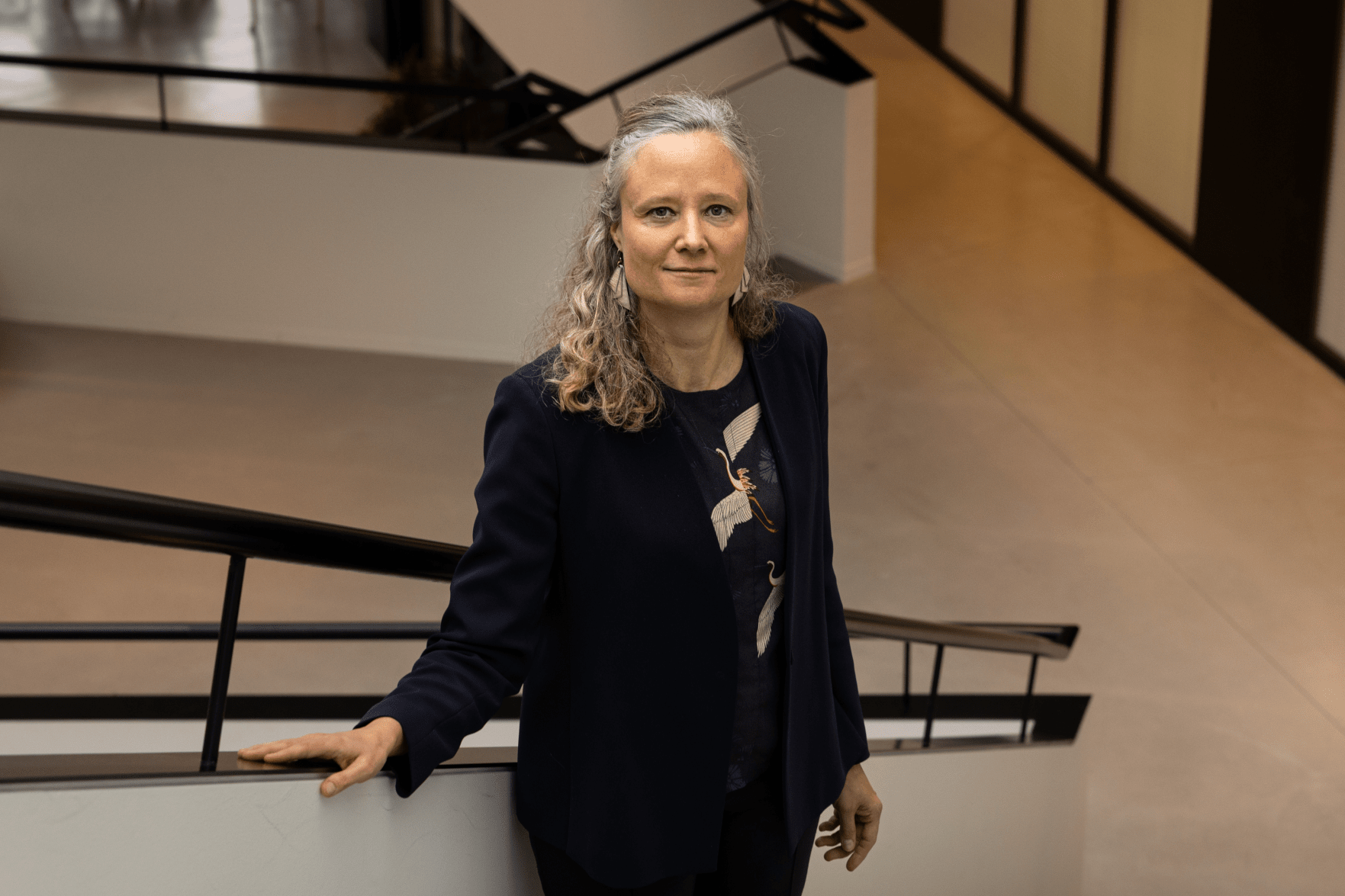
Beatrice Ferrari obtained her PhD from EPFL in 2013 and has been the Director of International Affairs for Geneva Canton since 2020. She’s in charge of building up and promoting Geneva’s status as a global hub for international cooperation, diplomacy and international organizations. She spoke with us about the challenges facing Geneva’s international sector in today’s turbulent global climate.
Where did you grow up, and why did you decide to study geography and ethnology in Neuchâtel?
I grew up in Ticino Canton. During my third year of junior high school, I went on a week-long class trip to China. That was in the 1990s and most of us had never been outside Europe. China seemed very exotic, far removed from the life we knew. That trip stayed with me, and after finishing high school I went back to China to learn the language. It was an exciting year – I got to see first-hand the rapid urban, social and economic changes taking place in the country. When I got back to Switzerland, I decided to study at the University of Neuchâtel because there I could combine geography, ethnology and political economy. I believed those subjects were key to understanding the world around us. But I never lost my interest in China and chose Beijing as the topic of my master’s thesis.
What brought you to EPFL for your PhD?
My master’s thesis supervisor at Neuchâtel was well-acquainted with Jacques Lévy – a geographer and urban planner who was an EPFL professor at the time. Jacques was looking for PhD students, and China was a subject he was interested in. That’s how I came to EPFL. I completed my PhD on Beijing’s transformation and its emergence as a city of innovation. I took an urban-planning approach that also incorporated aspects of geography and social science. I looked at local entrepreneurs, innovators and artists in particular, and how they used the city’s resources for their work. Change was happening all over the city, especially to get ready for the 2008 Olympic Games. China in general was becoming more global and also establishing its place in the world. You could really feel that in its urban areas.
After your PhD, you spent seven years working for the Swiss State Secretariat for Education, Research and Innovation (SERI). What were the issues you dealt with?
I was already familiar with SERI because it coordinates the Swissnex knowledge-exchange network that Switzerland had set up around the world, and I had been in contact with the network while in Beijing. When I joined SERI as a scientific advisor in 2013, I was primarily in charge of managing bilateral relations with a group of countries, including China, in the areas of research and innovation. The goal was to form partnerships that could give researchers more opportunities for collaboration and funding. My remit covered other Asian countries too, such as Japan and South Korea. With South Korea I was basically starting from scratch.
In 2018, I was named head of bilateral relations. We strengthened our collaboration with Innosuisse and the startup ecosystem, whose potential was largely untapped. A lot of heavy lifting was needed to persuade people of the benefits of partnering with “emerging” countries. We also began working more closely with the Swiss National Science Foundation to help it establish agreements with its counterparts in other countries. And we rolled out various programs to help Swiss PhD students adapt to foreign markets and to practices that they probably weren’t accustomed to.
We also promoted Switzerland’s approach to vocational education, as many countries looked to us as a model. Some challenges – such as teaching skills that are directly applicable in the job market and updating educational programs over time – are universal.
In 2020, you were appointed Director of International Affairs for Geneva Canton. Can you tell us about your role?
It was a newly created position when I was hired. Until then, issues related to Geneva’s international sector and international cooperation were handled by different units. The Canton decided to group these activities within a single, dedicated structure. Today it has 14 employees. An estimated 35,000 people work for international organizations in Geneva, which corresponds to 8% of jobs in the canton. If we include employees’ families, then we’re talking about over 50,000 people.
Our primary function is to support international organizations in Geneva, including those that are just getting set up. For instance, for people who want to create an NGO or foundation, we help them establish a legal entity and find office space. This includes working closely with the Swiss federal government because these efforts are directly related to the country’s foreign policy. In addition, Geneva Canton has a law that requires the cantonal government to allocate some of its budget to international cooperation. We’ve granted over CHF 17 million to organizations to support their work in the areas of humanitarian aid, human rights, global health and the environment.
We’ve heard a lot about the funding cuts – especially by the US – for international organizations. Is that the biggest challenge you’re now facing?
The total budget for international organizations had grown by a factor of four or five since the 2000s. This trend picked up during the pandemic as more funding was allocated to global health programs. But the amount of funding stagnated in 2023 and then began to decline.
That was also when countries in the West – which are the main sources of funding for international organizations – gradually started shifting their budgets towards other priorities, including defense. But it’s true that the latest US funding cuts have hit particularly hard, as the country accounts for up to 40% of the budget of some large international organizations. Geneva is also home to nearly 500 NGOs, which have also been impacted by the drop in funding.
We can’t expect funding to return to past levels. Instead, we need to think about how we as a society want to address the major global challenges we now face.”
What tangible consequences have you seen?
Beyond the issue of funding, we’ve noticed that people are starting to rethink the very architecture of international cooperation and multilateralism that emerged from institutions established at the end of the Second World War. The core values underpinning this architecture – such as sustainability and human rights – are also under threat.
All this is taking place at a time when the number of conflicts worldwide has never been higher, when regions are becoming increasingly unstable and when needs are constantly growing. And, of course, this has also impacted Geneva. A recent study estimated that every job in the canton’s international sector generates 0.25 additional jobs, either at suppliers or in the construction, hotel, cleaning or restaurant industry.
Is there a way to offset the lost funding?
We can’t expect funding to return to past levels. Instead, we need to think about how we as a society want to address the major global challenges we now face – challenges in the areas of climate change, trade and the use of new technology. These problems won’t just go away. Responding to them will require international organizations, skilled workers and know-how. But this is a pivotal moment for Geneva’s international sector, and we need to accept that we’re entering a new era.
Which organizations have been most affected?
Some are struggling more than others. The World Health Organization was severely impacted owing to its heavy reliance on US funding, and the Office of the United Nations High Commissioner for Refugees has seen its budget shrink by nearly 40%. On the other hand, the International Telecommunication Union hasn’t experienced much of a change.
In addition to working with international organizations, you also promote the instrumental role that Geneva and Switzerland as a whole can play.
That’s right, and I would say that Geneva has certain advantages in the current crisis. Notwithstanding the headwinds, five additional countries have set up a permanent mission here in the past few years, and others should follow. Geneva is the only city besides New York where nearly all nations are represented. We are also a space where international armed groups can sign deeds of commitment, such as to not recruit children or commit sexual violence. That can’t be done in other countries since members of the groups wouldn’t be able to obtain a visa.
These examples show that most nations realize it’s useful to hold global discussions and to do it here, in a country that’s still neutral, whereas it would be harder elsewhere in today’s increasingly polarized world. That said, we need to stay objective and bear in mind that the multilateral system was generally built according to criteria set by countries in the West. Other nations are calling for a bigger role, and that’s perfectly justified.
Can science and technology contribute to international relations and diplomacy? How can a school like EPFL be useful?
Geneva’s international sector is home to a pool of experts on global issues who want nothing more than to join forces with researchers! Such partnerships are worth setting up, and now is the right time since international organizations are being forced to change how they operate in response to the current crisis.
There are numerous examples. Artificial intelligence is certainly the most salient topic, especially since Switzerland is a driving force. We helped finance the UN International Computing Centre, which provides services to international organizations anywhere in the world. It’s very interested in working with EPFL.
Also, UN-Habitat, which promotes sustainable cities and aims to improve living conditions for people worldwide, would like to tap into Switzerland’s expertise in new approaches to housing. Other, more technical organizations are exploring subjects such as data processing, data storage and cybersecurity. Blockchain can be an important tool for organizations that provide services to displaced persons in order to protect these individuals’ identities and give them access to financial services.
And finally, some organizations are working on issues like antibiotic resistance and neglected diseases. They’re obviously interested in teaming up with researchers in these fields to develop drugs that wouldn’t be commercially viable.
Geneva’s international sector is a genuine innovation hub with strong values, and it plays an essential role: we’ll always need places where we can find solutions
What do you enjoy the most about your job?
First of all, its variety. On any given day, I could find myself working on projects related to cybersecurity, humanitarian aid, urban planning and public-private partnerships. Next, I would say the people I work with. I’m lucky to be able to interact with motivated, hard-working and determined professionals to tackle global problems.
I also think not enough credit is given to the innovation that’s going on in Geneva’s international sector. People think it’s a highly bureaucratic operation – but that couldn’t be further from the truth. Geneva has a solution-oriented culture with experts from around the world who, even if they represent different stakeholders, can sit down at the same table. It’s a genuine innovation hub with strong values, and it plays an essential role: we’ll always need places where we can find solutions.
You’ve also taught at EPFL, from 2008 to 2024. What did you gain from that experience?
When I was a PhD student, one of my colleagues – an architect and urban planner – suggested we teach a class on urban planning in Switzerland. At first, I worked with her to introduce some concepts from Asia, since we felt it was important to broaden our students’ horizons. But we ended up creating a class specifically on urban planning in Asia, initially focused on China and Japan and later expanded to other countries in the region. I continued giving the class with Prof. Graezer Bideau.
By teaching this class, I was able to continuously update my knowledge of urban planning. And I loved the academic environment. Interacting with students was very gratifying because they always bring a fresh perspective and awareness of new issues. I also witnessed how their interest in Asia grew over the years. Few people signed up when we first introduced the class in 2008. But starting in the 2010s, attendance boomed and many more students traveled to China, such as to complete internships. The class size reached 75 or 80 students, which is a significant number.
How have your studies at EPFL helped you in your career?
At EPFL, I learned how to think things through and explain complex concepts clearly. I also gained a lot from the broad range of disciplines. As a PhD student, I found it amazing to be able to study urban planning while getting input from architects and engineers. I have a background in geography and social science and was used to working with documents and maps. So speaking with experts who dealt in blueprints and models was invigorating. EPFL taught me how to communicate effectively with people from a range of scientific fields. That’s a useful life skill in general, and even more so in my current position.
BIO
1999
Spends a gap year in China
2006
Obtains a master’s degree in geography, anthropology and political economy from the University of Neuchâtel
2013
Obtains a PhD in urban planning from EPFL
2013
Joins the Swiss State Secretariat for Education, Research and Innovation
2020
Appointed Director of International Affairs for Geneva Canton
Photos: EPFL/Mathias
Comments0
Please log in to see or add a comment
Suggested Articles