“Look for a medical need, and you'll find your way” Guillaume Petit-Pierre, CEO of Artiria Medical


EPFL graduate Guillaume Petit-Pierre is the CEO of Artiria Medical, a medtech firm that has developed an ingenious, deflectable guidewire enabling surgeons to easily navigate the sinuous blood vessels in the brain and treat strokes. We caught up with Petit-Pierre, who’s active on many fronts – but rejects the label “hyperactive.”
Guillaume Petit-Pierre completed much of his higher education at EPFL, starting with his bachelor’s degree in mechanical engineering. He then transferred to ETH Zurich for a master’s in biomedical engineering and biomechanics. Once back in the French-speaking part of Switzerland, he took a job as a project manager for Valtronic Technologies, a company that makes medical implants. “We developed devices for just about every part of the body, from the urinary tract to deep inside the brain,” says Petit-Pierre.
From a young age, he was drawn to two fields in particular: aerospace and medicine. “My wife comes from a family of doctors – her brother and both her parents,” he says. “I met her when I was a university student, so perhaps that influenced my decisions.” Petit-Pierre’s interest in aerospace, however, dates back to a curious incident when he was a child: “One day I found a crashed model airplane lying next to a garbage can. My father and I tried to repair it, unsuccessfully. The next year I was given a model airplane to build for myself. I think that’s also what made me want to become an engineer.” He even went on to obtain a pilot license.
As someone who loves a challenge, Petit-Pierre enjoys all sorts of sports – triathlon, snowboarding, ski mountaineering, mountain climbing and more. He describes himself as “multi-active” rather than hyperactive. He’s taken part in the Patrouille des Glaciers ski mountaineering race seven times. “My craziest memory is when we encountered really strong winds on the Tête Blanche. The wind was blowing so hard that one of my ski poles, even though it was attached to my wrist, went horizontal!” Not only does Petit-Pierre enjoy learning new things, he’s clearly also very determined.
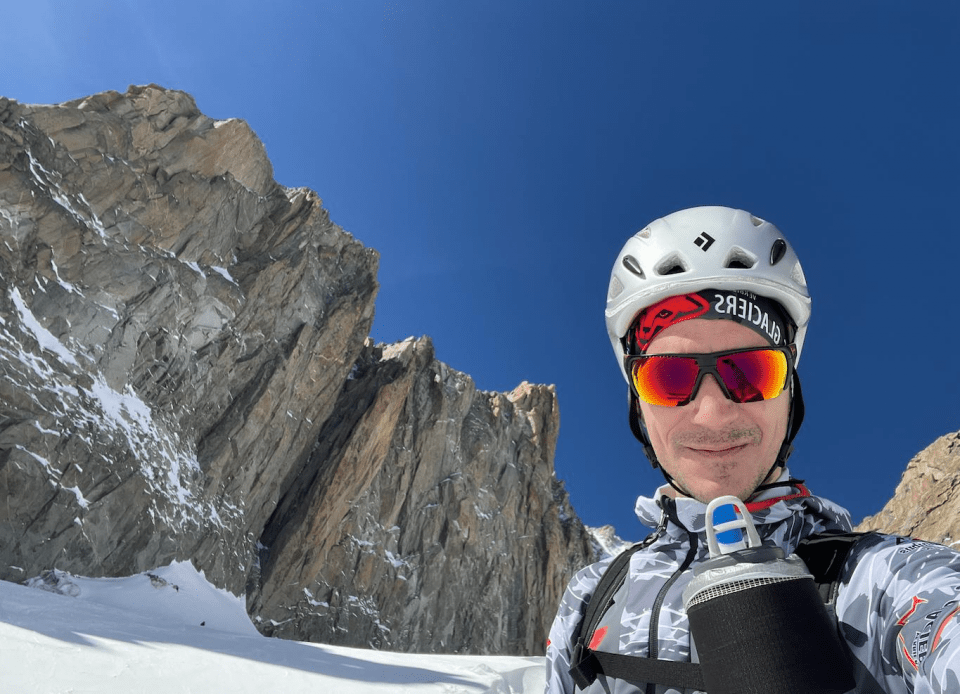
Guillaume loves challenging sports @ Guillaume Petit-Pierre
After spending several years at Valtronic, Petit-Pierre decided it was time to return to research. He took an opportunity to join EPFL’s Microsystems Laboratory 4 (LMIS4), headed by Philippe Renaud, as a PhD student in bioengineering. “Creating a startup wasn’t in my plans when I arrived at LMIS4,” says Petit-Pierre. “But without realizing it, I’d chosen a highly proactive research group where roughly half of the team had received a grant to turn a business idea into a startup. It was almost part of the group culture.”
One of these young entrepreneurs was André Mercanzini, one of the founders of Aleva Neurotherapeutics, which designs and manufactures deep brain stimulation technology. “I’ve always considered André as my mentor,” says Petit-Pierre. “He would say, ‘Look for a medical need, work with doctors, and you’ll find your way.’ With his encouragement, I created Artiria Medical in 2019 with my friend Marc Boers, another researcher, who was also excited about medtech and the possibility of starting a business.”
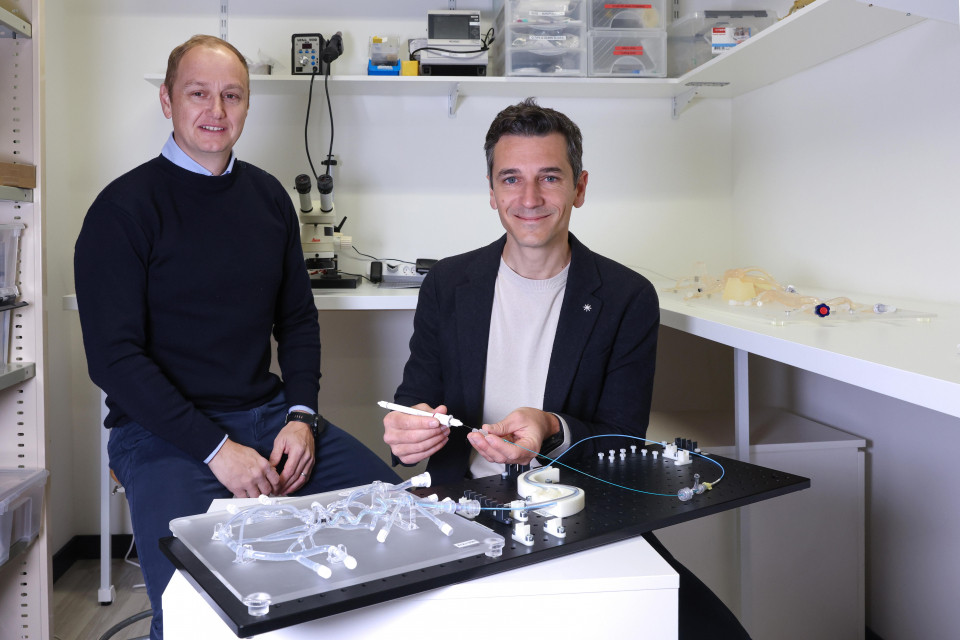
@ Alain Herzog 2026 - CC-BY-SA 4.
Petit-Pierre followed his mentor’s advice to the letter. “My PhD thesis was on neurosurgery and I spent several days shadowing doctors at the Geneva University Hospitals,” he says. “Then I met interventional neuroradiologists who explained that it’s possible to perform brain surgery by passing through the body, such as to implant a stent or remove a blood clot.”
His career took a decisive turn when Dr. Pascal Mosimann at the Lausanne University Hospital’s neuroradiology department invited Petit-Pierre into the operating room. “During the neurovascular procedure, ten people were in the operating room along with screens displaying extremely high-precision X-ray images that showed the doctor’s movements inside the patient’s brain in real time,” says Petit-Pierre. “Yet despite the advanced technology, the doctors still had to take out the guidewire and bend it by hand so that they could feed it through the cerebral blood vessels to reach the lesion. I’d found my medical need!”
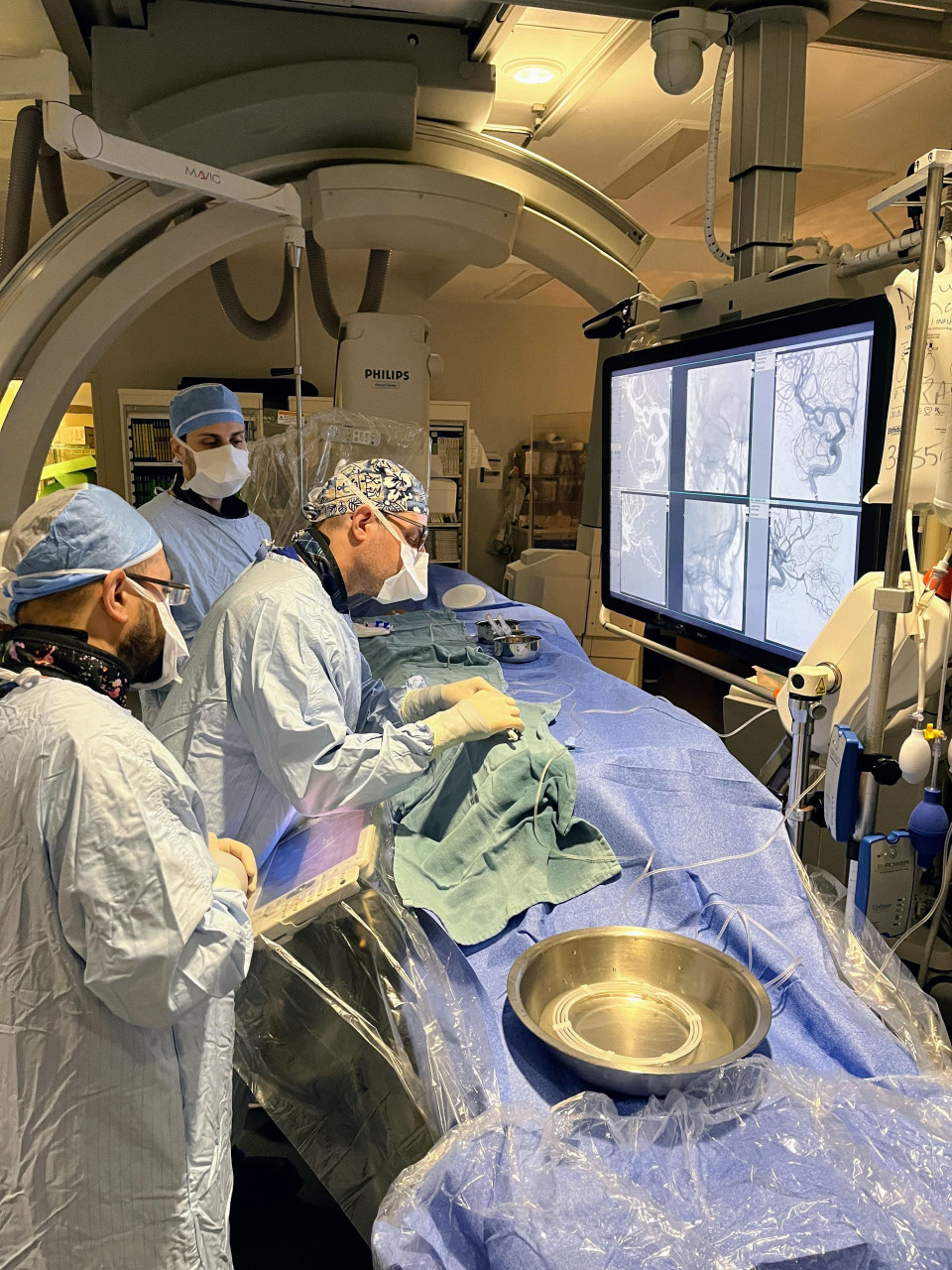
“At first we tried to adapt and improve an existing device, and even asked EPFL students to investigate various options,” says Petit-Pierre. “Then we switched to a different technology and developed SmartGUIDE – a soft guidewire with a 360-micron circumference that can be deflected in situ using a mechanism on the handle. It’s a bit like Ariadne’s thread. It finds a path from the neuroradiologist’s hand to the injury within the brain that needs treatment.”
In starting his new business, Petit-Pierre was able to combine everything he loves: continually challenging environments, lifelong learning and intellectual freedom, without being boxed into a single discipline. His role as CEO encompasses many fields – from customer relations and finance to strategy and business development – as well as a host of tasks: working closely with doctors, navigating the regulatory environment and putting together applications with very demanding specifications. All these efforts paid off, however, when Artiria Medical obtained approval to use its device on a patient for the first time. “I even had to complete training on the process for running clinical trials in humans,” says Petit-Pierre. The firm’s deflectable guidewire received clearance from the US Food and Drug Administration in 2023 and more recently obtained the CE Mark from the EU, certifying that it complies with EU medical device regulations.

and the lesion that the neuroradiologist will treat @ Artiria Medical
“I find the human body fascinating,” he adds. “If I had to do it all over again, I’d probably become a doctor. It’s an amazing job – you get to improve people’s lives and well-being in general. What we’re doing with Artiria is exactly along those lines. We help people.”

Comments0
Please log in to see or add a comment
Suggested Articles