
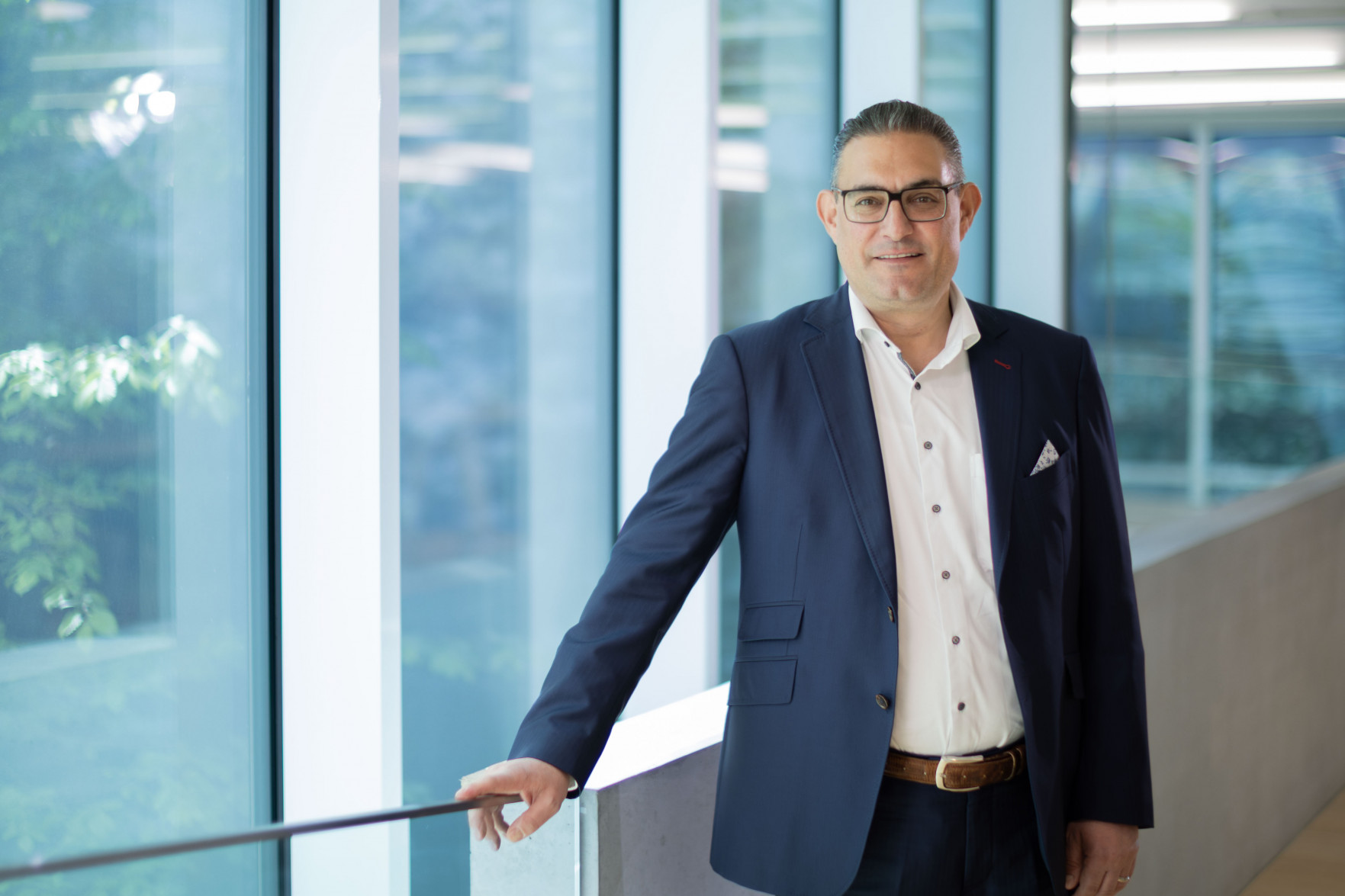
Since January 2026, Samuel Schär has been the CEO of Bühler Group, a leading Swiss industrial group in food-processing and advanced materials processing technologies. For Dimensions, he explains the company’s impact on the products we consume every day and reflects on his personal journey, built on two pillars: his passion for science and his strong connection to EPFL, where he earned his degree in physics in 1999.
When we first reached out to you for this interview, you shared a video of yourself in your lab at the Swiss Plasma Center, when you were only 16 years old. Could you give us some more context? How did your passion for science begin?
Science was an inherent passion for me. It was driven by curiosity, and I was lucky to have a very scientific family environment. Everything was there for me: my grandfather got me into electrical experiments, and I inherited a chemistry lab from my uncles.
At the core of that passion was always physics and in 1992, when I was 16 years old and still in gymnasium, I was looking for some equipment to build a plasma accelerator. I got in touch with the Centre de Recherche en Physique des Plasmas (CRPP) in Lausanne and asked them for a high-voltage generator, an oscilloscope and more.
They invited me to Lausanne. When they welcomed me at the train station, they were surprised: they were probably expecting an older scientist, and there was this little boy. They offered me the opportunity to work at the institute, and I arranged my schedule with my school to come to Lausanne every Wednesday and Friday and all holidays. They also introduced me to Robert Keller, a former researcher at the institute, who became my mentor. It was all too good to be true!
In 1993, I spent some time in the U.S. taking senior-level classes in electrical engineering, which helped a lot. Then I came back to Switzerland and finished my project at CRPP. It won several awards, including first prize at the 6th European Union Contest for Young Scientists in 1994, and I got invited to the Stockholm International Youth Science Seminar and to the Nobel Prize festivities.
How did all these early achievements lead you to join EPFL?
It’s actually EPFL that invited me to study there. They offered to accelerate my education by allowing me to join without the maturité, and to complete the first and second year in one. That was a bit too fast for me, so I chose to complete my maturité during the first year and proceed year by year, so I could still have a social life.
I loved the fact that it was a campus in itself, apart from the city. I also loved the spirit of the people and Lausanne as a city. I became a student assistant in the class of Professor André Châtelain, someone who has been very important to me, among others.
I was working very hard but still managed to take part in many activities: I learned how to scuba dive, I joined Fréquence Banane and Artiphys, and we travelled to China with my class. I also participated in the Challenge in 1996. Last winter, I met a student wearing an EPFL jacket and asked him who had won this year. He told me EPFL had won, and I told him we did too in 1996!
Given your strong passion for science, why did you choose to move into consulting and then industry rather than pursuing an academic career?
I really thought I would do a PhD and become a physics professor. At the end of my studies, I developed a passion for quantum electronics and lasers, and joined the lab of Prof. Ursula Keller at ETH Zurich, before coming back to Lausanne for my diploma.
During my thesis, I spent my days in a dark room building an infrared laser. I was wearing night-vision goggles all day long, adjusting mirrors and waiting for the laser to turn on. After two months, something clicked: it could not be my future for the next three or four years. I wanted to have an impact beyond scientific results. In 1999, I was approached by McKinsey. They made me an offer that was a fortune for me at the time, and I accepted it. However, I quickly got drawn into banking rather than technology projects, and my passion for science resurfaced.
I quit McKinsey and went to South America, backpacking for three months. When I came back, a friend from EPFL, who was founding his company, invited me to join. I invested the pension fund I had accumulated, but the project did not work fast enough. I ran out belief and money and had to look for a job. That’s how I joined Bühler in 2002.
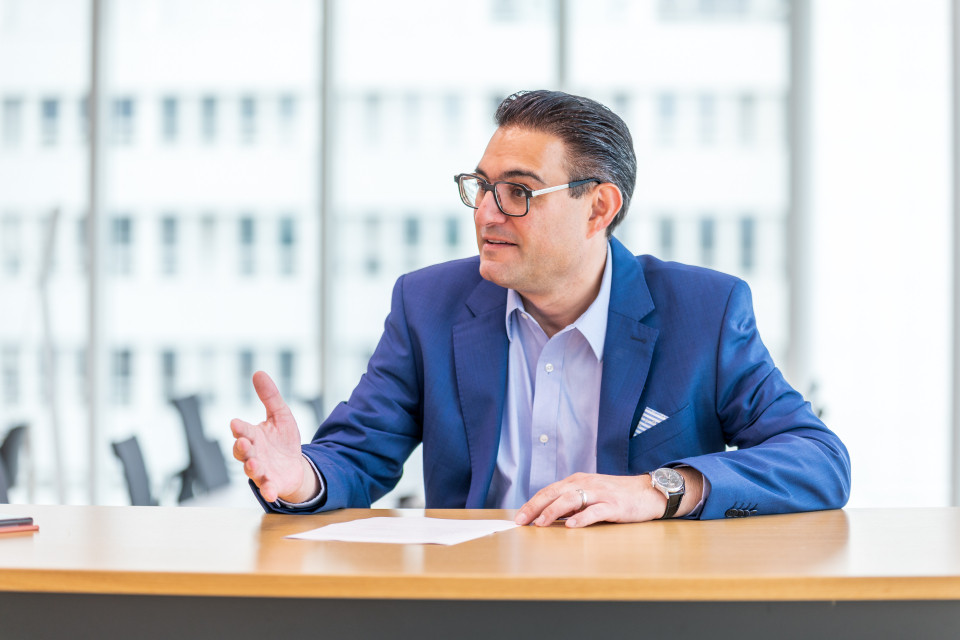 Photo: EPFL/Dimensions Samuel Schär
Bühler is not always widely known by the general public, yet billions of people consume products processed through its technologies every day. Could you walk us through how its business is structured?
Bühler is a solution provider in the sense of delivering plants, equipments and services for processing industries in food and feed, as well as for a variety of other industries, mainly automotive, optics and inks. We call this business “Advanced materials”. Bühler is a B2B company, and its customers use its solutions embedded in their value chains to produce their own products, so that’s why end consumers may not know Bühler.
The company employs over 12,000 people, including 2,300 in Switzerland, and its business is very equally distributed around the world in 140 countries. The largest region is Europe, which represents around 30 percent of the revenue, then with 24 percent the Middle East, Africa and India as the fastest growing regions with their increasing population. The rest is equally split between Asia and the Americas.
How do you see the company's impact on value chains and the end consumer?
The impact of our technologies on value chains is significant. If you bite into a piece of bread anywhere in the world, there’s a good chance you are, so to speak, biting into Bühler. About 65 percent of the world’s flour is produced in mills built by Bühler. For chocolate, it’s 60 percent; for malting, it’s 70 percent. If you drive an electric car, its cast parts, battery materials, or optical components may have been produced with Bühler solutions.
I’ll give you a historical example to show that the spirit of innovation was present from the beginning. The company started in 1860 as an iron foundry, and Adolf Bühler quickly realized that if you just make parts, there’s a lot of competition. So he developed a special centrifugal casting process to create a hard grain structure. This made it possible to produce rolls suited for grinding wheat. Until then, milling relied on grinding stones that pressed down with great force but also wore themselves down, leaving traces of stone in the flour.
With these roller stands, it became possible to industrialize flour milling. Now, modern flour mills typically grind 300 to 1,000 tons per day.
Bühler’s scope may seem broad, but there is a clear logic. The same unit operations can be applied across industries, allowing proven technologies to enter new markets. For example, die casting machines were initially developed for internal use, but customers asked for them as well. Similarly, technologies used for breakfast cereals are now applied to plant-based meats and to lithium-ion battery materials.
How do you combine production efficiency with health and safety?
The first element is hygienic design, which ensures there are no contamination points and that machines can be cleaned and maintained very easily. In addition, numerous control loops and monitoring systems are implemented to make sure industrial specifications are consistently met. In the flour industry, for example, the “ash loop” monitors and controls the ash content of the flour. Similar systems exist across many other applications.
Building a plant is a long-term commitment: equipment must perform over decades, future investments must be protected, and operators must be trained. Without skilled millers, even the best plant cannot fulfill its purpose. Equipment and service go hand in hand.
You have spent most of your career at Bühler and became CEO in January 2026. What were the key turning points in your journey?
I started at Bühler in a special exploration initiative, testing new business models around an agitator bead mill for the ink business. It exposed me to many industries, and was an incredible training ground, a tech geek’s Eldorado combined with solid development experience. That was my first turning point. Next, I became Managing Director of the business unit for this technology, my first larger P&L responsibility, leading a CHF 100 million business for four years. After an acquisition in optical thin film coatings, I joined the division’s executive board and helped turn it around.
The third turning point came in 2020, when a close colleague passed away. I then became Chief Services and Sales Officer while still leading Advanced Materials. During the pandemic, it was a complex period. Two years later, I handed over Advanced Materials to focus on international customer-facing organizations, a path that naturally led to the CEO role I hold today.
As the new CEO, what are the main challenges and opportunities you face in this role?
I’m only the seventh CEO in Bühler’s 166-year history. It’s a family-owned company, and many of its customers are as well, so my role is to ensure continuity with evolution. A key challenge today is resilience, with some regions facing conflicts and disruptions. However, the diversified solutions portfolio across regions and industries keeps us stable through crises, from pandemics to wars. As for opportunities, in addition to Africa, the Middle East, and India we mentioned earlier, China is a focus for innovation.
Service plays a major role and will become even more central. It’s not diversification; it’s a natural extension of partnering with customers across the full lifecycle. Building a plant is a long-term commitment: equipment must perform over decades, future investments must be protected, and operators must be trained. Without skilled millers, even the best plant cannot fulfill its purpose. Equipment and service go hand in hand.
How and in which areas can industrial companies have a meaningful impact on sustainability?
Energy efficiency is one area where the results are clear. For example, in lithium-ion battery production, switching from batch mixers to continuous extrusion lines reduces energy use by over 80%. In the food industry, flour mills generate side streams during processing. These can be repurposed for animal feed or converted into process heat or electricity, reducing overall CO₂ emissions compared with disposal.
For our own operations, as of December 2025, we had reduced our emissions by around 30% since 2019. But a larger part of our impact comes from the value chains of our customers. In 2019, we set a target that by 2025 our solutions should enable customers to reduce energy use, water consumption, and waste by 50% each. Today, across 15 major value chains, 11 already achieve at least one of these reductions.
Sustainability is closely linked to operational efficiency: plants that run reliably and use energy effectively reduce costs while also lowering environmental impact. The work is ongoing, and we continue to explore solutions.
What are the roles of the innovation campuses you have at EPFL and in Uzwil?
Bühler’s innovation satellite at EPFL focuses on early-stage exploration, partnerships with research labs and startups, and building a bridge between academia and industry. Not every project becomes a large business, but continuous exploration ensures that promising ideas can grow.
Our Cubic Innovation Campus in Uzwil, inaugurated in 2019, is part of a global network of 26 research and training centers. It allows customers to test recipes and processes at pilot scale, which is often not possible on their own equipment. Each site in the network has a specific role. For instance, in Kemptthal, we run The Cultured Hub with Migros and Givaudan. Startups can scale cultured food products from 100 to 1,000 liters in a fully equipped pilot facility, helping them validate concepts before investing in a plant. Overall, innovation and open innovation are clear priorities: around 5% of Bühler’s turnover is invested in R&D.
How is AI impacting Bühler’s business, and what role does your collaboration with the Swiss Data Science Center at EPFL play?
We take a very practical approach to AI, using it as a tool where it creates value. We were among the first industrial partners of the Swiss Data Science Center, and this partnership has already led to several applications.
One example is the malting process. There, we use AI models to analyze weather conditions and humidity in order to optimize the drying process. It is a critical balance: if you under-dry, there is a risk of spoilage; if you over-dry, you waste energy. AI helps identify the optimal point. We also use AI in grain milling, what we call the “smart mill”. Multiple control loops are analyzed, and AI helps detect patterns that have reduced the risk of quality deviations by around 80%.
Is it challenging to recruit engineers?
The war for talent is obviously on. You have certain centers where a lot of talent is naturally attracted, like Lausanne or Zurich, and we are a bit outside of these hubs as well. What helps us is our purpose: to contribute to feeding and moving the world through technology.
As for recruitment, it is often about matching the right skill set. Sometimes we look for a specific skill, but that skill is not available, while other interesting profiles are. But even more important for us is cultural fit.
Are there specific skills that make a real difference for you? What can EPFL learn from that in terms of education?
We look first and foremost for strong fundamentals and this is something EPFL does very well. It provides rigorous training in core disciplines, while encouraging cross-disciplinary thinking and pragmatic problem-solving beyond traditional silos. That combination is exactly what we need: people who are able to take a holistic view of a problem, who understand what they can contribute, but also recognize the limits of their expertise.
They need to be comfortable stepping out and asking for help when necessary. That ability is critical, because complex problems are rarely solved in isolation. We often talk about the difference between a “know-it-all” and a “learn-it-all”. For us, it is very clear: we are looking for people who are willing to continuously learn, adapt, and collaborate.
You studied both at EPFL and ETH Zurich. Where does your heart lean?
Rationally, I have a strong connection with ETH Zurich: I lectured there and serve on advisory boards. But emotionally, I spent four years of my youth at EPFL, at a time when your character is truly shaped. That naturally creates a strong attachment, and nothing replaces your alma mater. So, my heart leans toward EPFL, and I wear that proudly, but it’s all friendly rivalry in the end. The strength really lies in the ETH domain as a whole.
What advice would you give to EPFL students who are about to graduate and think about their future?
Take full advantage of everything EPFL offers. Enjoy your studies but also have a social life: these years are formative, not just academically. And for your future, listen to your heart. Don’t chase prestige or monetary rewards; focus on your passion. Where your heart points, the rest will follow naturally. It’s simple, but it works: when you pursue what truly excites you, impact and success tend to follow.
PROFILE
1992
Joined the CRPP, at just 16 years old
1999
Graduated in Physics from EPFL
2002
Joined Bühler Group
2013
Appointed to the Executive Board, Head of Advanced Materials
2020
Named Chief Services & Sales Officer
2026
Named CEO of Bühler Group
Photo d'en-tête: EPFL/DR Samuel Schär

Comments0
Please log in to see or add a comment
Suggested Articles