

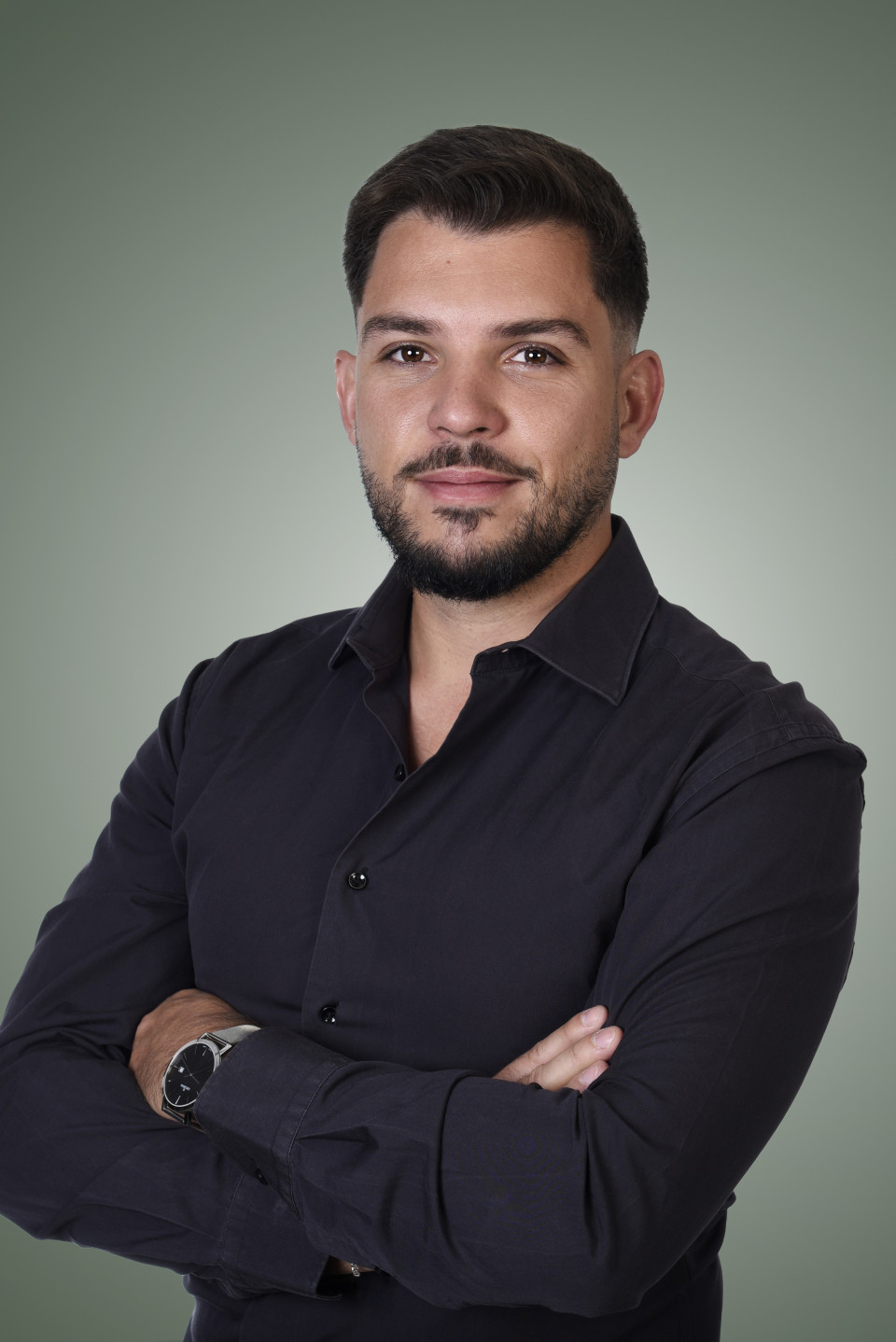
Driven by a desire for social justice rooted since childhood, Victor Cannilla followed a path traditionally regarded as “prestigious”. A graduate with a Bachelor's in Physics and a Master's in Financial Engineering obtained in 2016, he began his career as a trader and then a consultant, before devoting himself fully to his concerns, breaking through into an academic career focused on post-growth.
Born in Lausanne, to a Portuguese mother and a Sicilian father, in a family of modest income, Victor Cannilla developed an ease with mathematics and physics, despite a sometimes chaotic schooling.
While his parents worked at the Golf Club de Lausanne, he was disconcerted by the disparities in wealth and the arbitrariness of social statuses. From then on, the question of inequality and power would remain at the heart of his concerns.
Without too much clarity about his direction, he opted for a Bachelor's in Physics at EPFL, thinking that it would open many doors for him.
“Accepting the loss of social prestige and setting aside a lucrative, ready-made career was not easy.”
Curious, inspired by figures such as the sociologist Jean Ziegler, a professor at the University of Geneva and UN Special Rapporteur on the Right to Food, he considered a Master's in political science. He chose, however, to stay at EPFL, whose international recognition reassured him, and joined the Master's in Financial Engineering.
His first job as an algorithmic trader did not convince him. He saw how the major economic and political dynamics underlying derivatives are dealt with only through mathematical signals, in an artificial and opaque way.
In his own words, he then “re-educated” himself by taking an interest in heterodox economics and in the history of the West's imperial dynamics, which call into question the dominant economic mainstream and his own training in market finance.
After resigning and giving up finance, he continued his journey as a strategy consultant at Boston Consulting Group. The recruiters dangled before him the possibility of working on topics with a positive impact, but he soon became disillusioned.
“90% of projects generate either workforce reductions, commercial accelerations or greenwashing; 9% are devoted to government projects of questionable ethics. The positive-impact projects with WWF or the WHO, to which he was able to contribute after much perseverance, ultimately represent only 1% of the whole.”
His scepticism and anger grew in the face of the “indoctrination” he had felt throughout his journey, and the absence of any alternative vision. He resigned from BCG in 2021.
Six months later, he took online courses in political ecology and degrowth, offered by the Autonomous University of Barcelona. He also discovered associative and activist groups, as well as schools of thought other than those taught at EPFL.
He met Julia Steinberger, a professor of ecological economics and industrial ecology at the University of Lausanne, a lead co-author of the IPCC and politically engaged. Victor, who wished to do a thesis, approached her, and after completing a Master's in the political economy of capitalism at the University of Geneva, he began a thesis with her in 2023.
Alongside this career change, he co-created the activist collective AG!SSONS in 2021 and launched a science communication YouTube channel, @Kraken Debrief, in 2022.
His doctorate is taking place at UNIL within the REAL project. It aims to study the public policies and social transformations needed for a just post-growth transition, allowing everyone to live within planetary boundaries.
“My nerdy side appreciates the theoretical approach, but I understand that other people are looking for work with a more immediate, direct or visible impact.”
Victor Cannilla is now considering an academic career, provided that it serves society and is not confined to the technicalities of the “ivory tower”.
He enjoys making the complexity of this world accessible, spreading the “cognitive shocks” he himself felt while reading or listening to other people.
If he had any advice to give to people seeking their path, he would suggest being honest with oneself, and committing to careers that are intellectually and ethically satisfying, without limiting oneself to what he sees as obsolete stereotypes of success.
His winding and rich path can only help us to question our own journeys anew.