

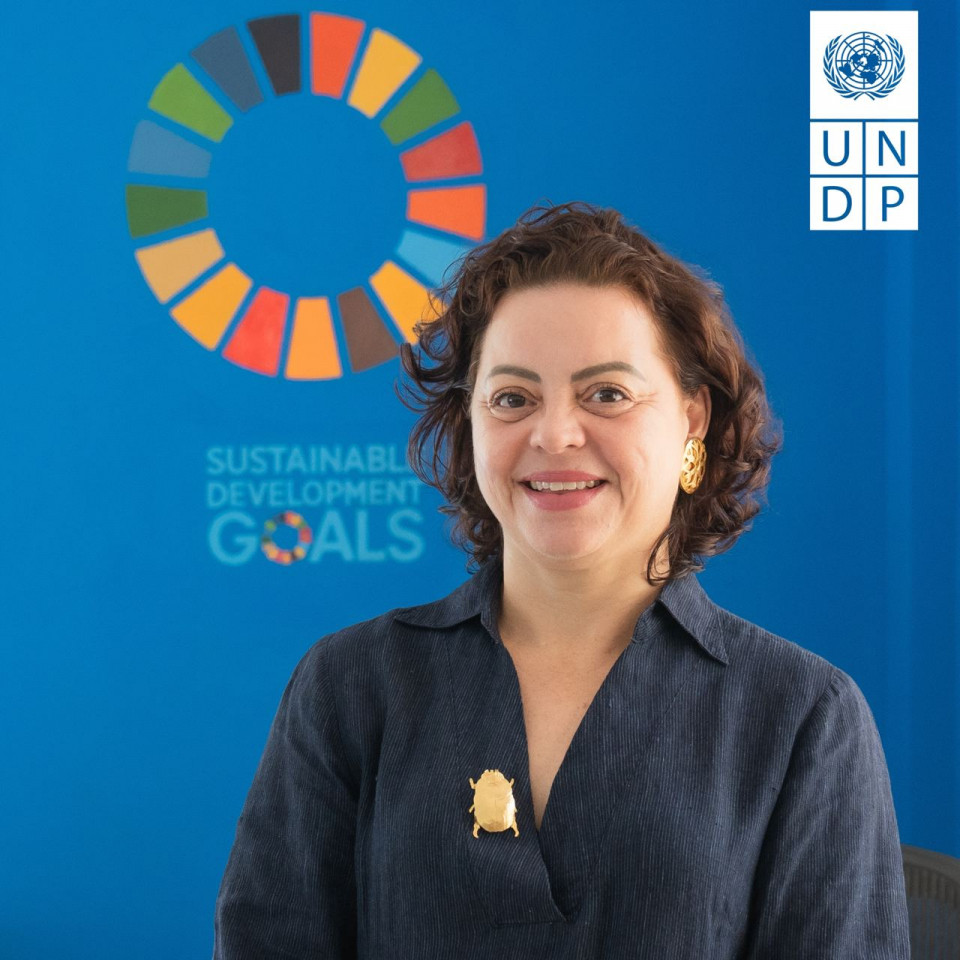
Resident Representative of the United Nations Development Programme, Alissar Chaker has devoted her life to working for human development and the protection of the environment, in crisis and post-crisis settings. She is sent to the four corners of the world, where she dedicates herself to what she calls the “business of hope”.
Born in Lebanon during the war, Alissar has been drawn to the preservation of natural heritage from a very young age: “I couldn't play outside or enjoy the magnificent landscapes my country had to offer. It was that absence which sharpened my curiosity and sparked my interest.”
She began her academic career with a bachelor's degree in agricultural engineering with a specialisation in health control, as there was no environmental programme at the American University of Beirut at the time. After research work carried out in collaboration with the University of Reims in France, which led to the description of an insect new to science, Synphlebotomus saltiae, a vector of leishmaniasis, a parasitic disease, she decided to refocus on the environment.
“It was technical work, very much focused on sustainable solutions, combining scientific skills with action in the field.”
She then began a Master's degree in Manchester in pollution and environmental control. On completing it in 1998, she was recruited for a World Bank project on the management of hospital waste and municipal solid waste in Lebanon, and then for a regional project funded by the European Union in Lebanon, Syria and Jordan for the integrated management of coastal zones.
It was with these experiences behind her that Alissar arrived at EPFL in 2002, where she followed the Master's degree in Environmental Engineering and Management. Shortly afterwards, she successfully applied to the Leadership Development Programme of the United Nations Development Programme (UNDP).
“I come from a country in crisis. For me, the UN played an important role and carried strong values.”
After a two-year posting at the United Nations Volunteers headquarters in Bonn, she moved to East Timor, where she worked on issues of social cohesion, security reform and disaster risk management.
She was then sent to Egypt in 2011 as regional crisis management officer, and afterwards to Libya following the fall of Gaddafi, to help develop the UNDP's support programme.
After giving birth, she spent three years in Syria, a country in the midst of war, alone without her family. She later found herself in Honduras, in a context of systemic violence, notably driven by drug cartels. There she worked on democratic governance, the environment, adaptation to climate change and poverty.
In 2019, she was sent to Tunisia to contribute to the democratic transition and social cohesion in the aftermath of the revolution. She then travelled to Cambodia, where she supported the protection of natural ecosystems and the implementation of the Paris Agreement on climate change.
Today, she is in Peru, where the UNDP helps to preserve the Amazon rainforest, among other things, and to promote socio-economic inclusion.
Her years at EPFL marked a turning point in her view of the world:
“I had a very technical, siloed perspective when I arrived at EPFL. But it was during my studies that I realised development could only be multisectoral.”
She concludes with an appeal to young people: “The most dangerous thing, in my eyes, is to have a youth disconnected from the reality of their country and the world.”
She leaves us with a small thought to reflect on: “Volunteering on nature-related causes when you're young helps you develop a certain sensitivity, but also a certain humility.”
👉🏽 Discover the 10 portraits of this series