

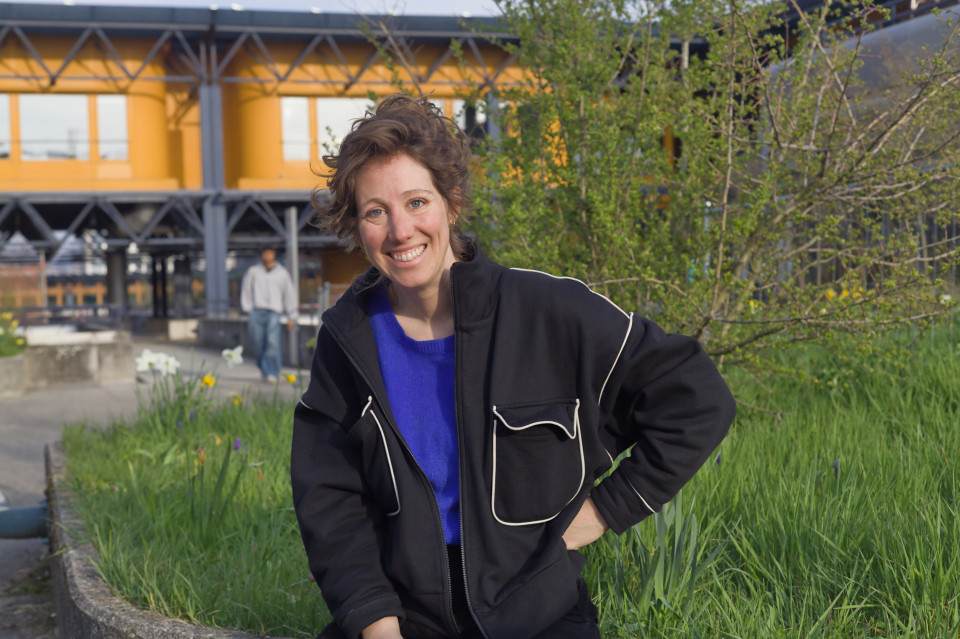
A 2015 graduate in Architecture from EPFL, Alice Chénais is an architect-urban planner at Atelier OLGa. Her approach to the profession: serving the common good.
Born in Lucerne, Alice Chénais grew up between French and German cultures. After completing her secondary education in Alsace in 2008, she enrolled in the Bachelor's degree in Architecture at EPFL. Her path continued with an Erasmus exchange in Vienna, followed by a gap year in Ecuador, between 2012 and 2013.
“There, I took part in building a shelter for women and children. The project drew on traditional architecture (cob, raw-earth bricks, and so on), combining it with more recent eco-friendly construction techniques. I appreciated being able to set the computer aside and discover collaborative, hands-on, agile and intuitive work.”
Back in Lausanne to complete her Master's degree, she realised that she was above all inspired by projects related to urban planning.
“It's a field where many connections are woven: between the territory in the broad sense and the very local scale, between places and the people who inhabit them. That's where encounters happen.”
After finishing her studies and working for three years at EPFL's urban planning laboratory, she co-founded Atelier OLGa with a friend, Jade Rudler, with whom she shares a common vision.
“Our approach aims to speed up processes, breaking with the timelines of conventional urban projects, and to involve residents from the very start of the thinking. This makes it possible to have a quick impact, by creating new welcoming spaces, installing amenities, removing asphalt and greening public space.”
From diagnosis to collective construction, Alice and Jade invite residents to take part in transforming their living environment. They create synergies between participatory worksites and local life, such as those moments when ongoing redevelopments sit alongside pizza ovens or concerts organised by local associations.
Some projects can, however, create divisions, particularly when spaces dedicated to cars are turned into places to meet or rest. “Making room for collective discussion and testing lets us check whether our proposals are right.”
In 2025, for example, their work on Place Robin in Vevey was a great success: furniture set up on the pedestrianised streets and embraced by residents, new planted gardens bringing more coolness, all carried out collectively over the course of a small neighbourhood festival.
“Citizen involvement remains essential for us. To achieve this, we invite local residents at the various stages of the process and build in room for manoeuvre on the worksites. We try to make these moments fun and enjoyable, so that the development becomes a driver for creating social bonds.”
Their work draws on their past experiences and evolves over the years, as Alice explains.
Work-life balance is essential to her: “At EPFL, in Architecture, there was a strong all-nighter culture. In our company, we value our free time, so we can get involved in associations and develop personal projects such as, in my case, illustration projects that are close to my heart.”
Alice's journey shows how the profession of architect-urban planner can be reinvented, through supporting local communities in adapting their living environments, designing spaces that respect environmental challenges, and creating social bonds.